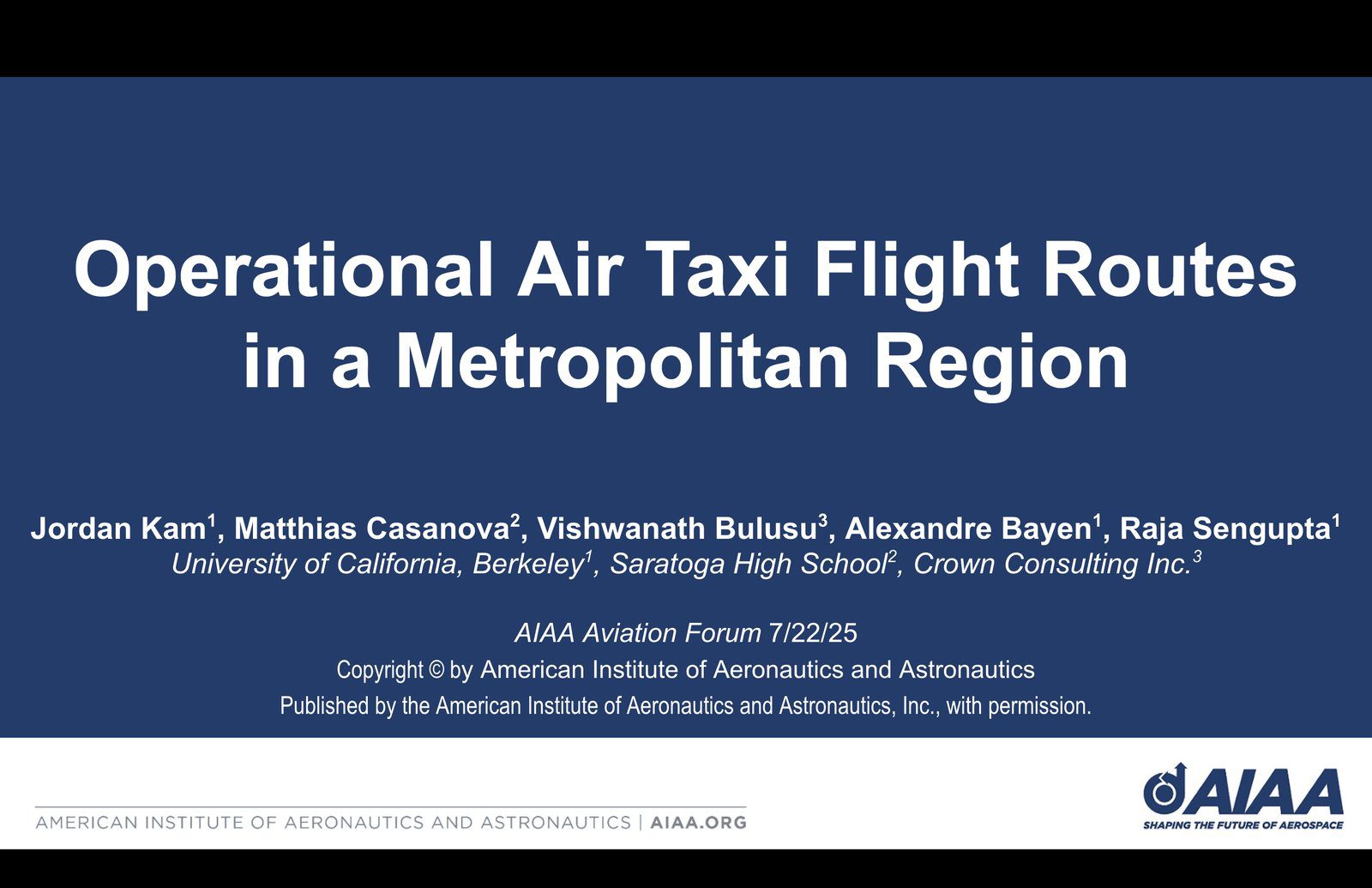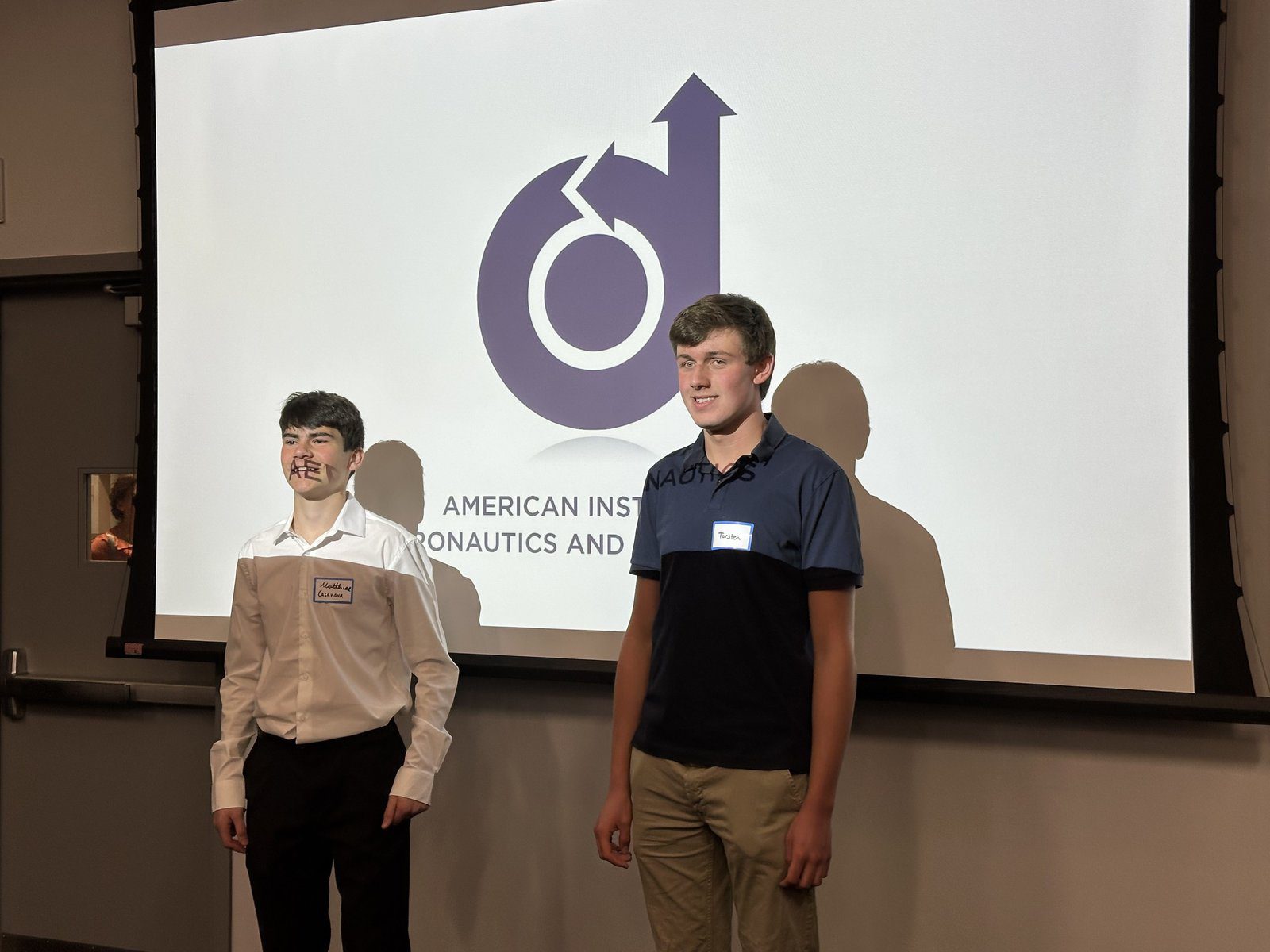
Over the past year, I’ve been fortunate to conduct research in collaboration with Professor Alexandre Bayen at UC Berkeley, exploring the future of Urban Air Mobility (UAM) and unmanned aircraft systems. This journey culminated in a milestone this spring: presenting our first research paper at the 2025 AIAA Region IV Student Conference at UC Irvine—one of the few to welcome high school researchers among predominantly undergraduate and graduate participants.
The paper I co-authored, “Design and Evaluation of an Air Transportation Network for Unmanned Aircraft Systems,” was the product of a months-long collaboration with fellow high school student Torsten Darell. Together, since we are both student pilots, we designed a flight network tailored for remotely piloted eVTOL aircraft, connecting four key airports across California: Moffett Federal Airfield (KNUQ), Hollister Municipal (KCVH), Merced Yosemite (KMCE), and Monterey Regional (KMRY).
Our goal was ambitious: to create safe and efficient UAS flight corridors that could operate under current FAA regulations and accommodate both urban and rural settings. We analyzed constraints like terrain, controlled airspace, and bidirectional traffic management to propose three primary routes—The Navigator Route, Valley Route, and Laguna Route—each addressing real-world airspace challenges.

We also tackled the design of vertiports at each airport, working with aircraft assumptions based on the Joby S4 and NASA’s quadrotor concept. Using Google Earth and FAA layout principles, we proposed pad locations that would minimize interference with conventional traffic while allowing efficient eVTOL operations.

Presenting this research at the AIAA conference was an exhilarating experience. Beyond the presentation itself, it gave us a glimpse into the professional aerospace community. We learned from university teams connected with engineers and students who share our passion of flight.


We’re now looking ahead to expanding the project: incorporating performance simulations and noise impact modeling of things such as blade vortex interaction. We hope our research can contribute meaningfully to the future of unmanned aviation.
Related Posts
Learn more about this research: Designing the Future of Air Taxis in the Bay Area and Mapping eVTOL Flight Between NASA Ames and UC Berkeley.