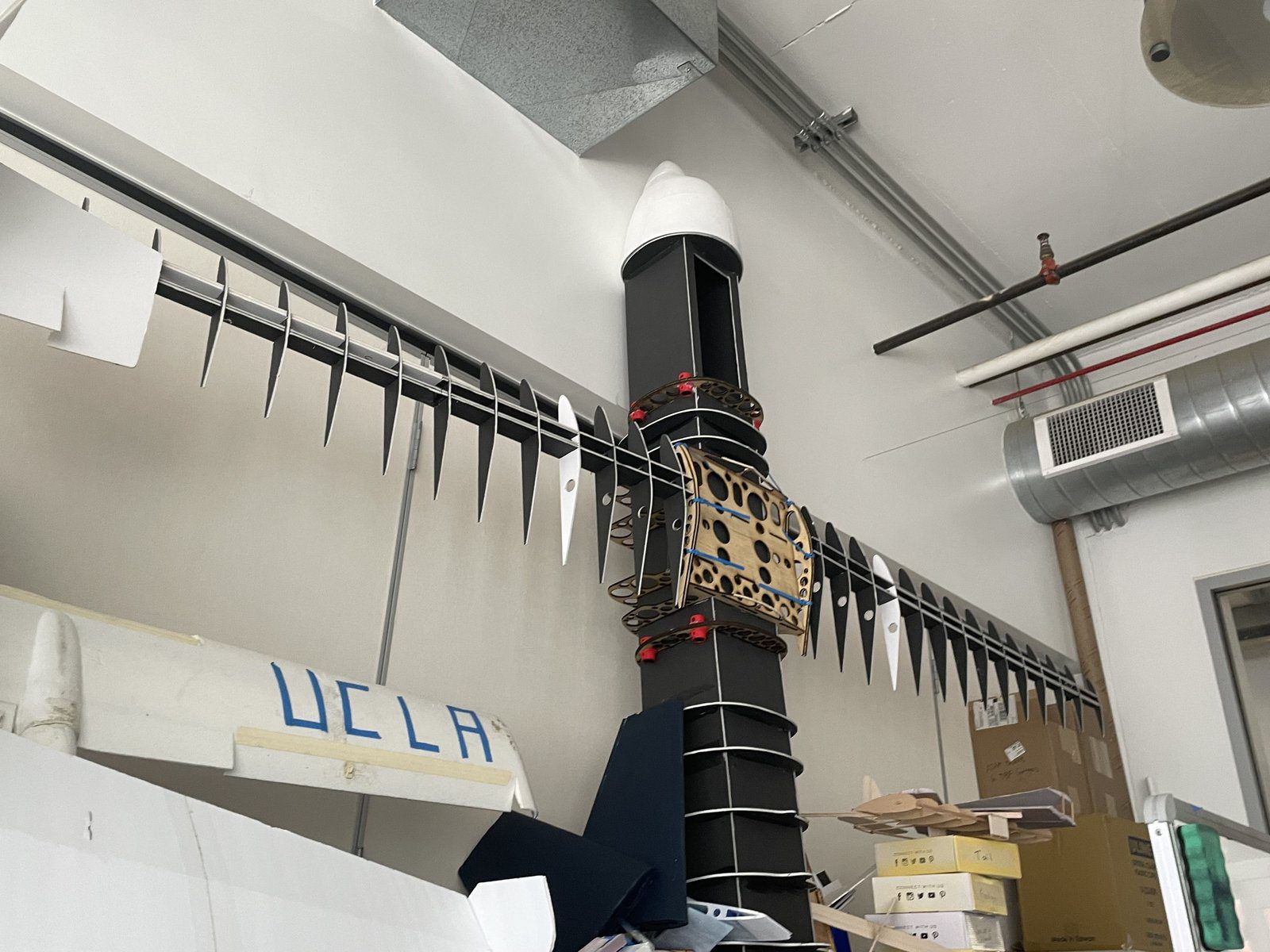
Students started the second day by being assigned teams. This allowed students to collaborate throughout the week through the various challenges, enabling them to share their ideas and draw solutions to issues.

First Glider Challenge
During the first challenge, students worked individually to fabricate gliders, however, a key concept was left out of most planes leading to poorly flying aircraft. Upon testing the aircraft from the first challenge students figured out the importance of having a center of gravity that is in front of the center of lift. In this second aircraft, my team and I set our focus on weight and balance. We even added screws to the front of the aircraft to improve its gliding capabilities.
Second Improved Glider Design
Our aircraft gliding performance was substantially better in comparison to the first glider I made, however, it unfortunately caught the wind and rolled right. This hindered our aircraft’s gliding capabilities as the bank caused our aircraft to lose lift. In addition, we did not have quite enough time to make our aircraft’s wings anhedral, so once the aircraft rolled right it was unrecoverable.
More about my UCLA U96 experience:
- UCLA E96A Plane Engineering: The Start of an Adventure
- UCLA E96A Week One Recap – Gliders, Part One
- UCLA E96A Week One Recap – Gliders, Part Two
- UCLA E96A Week Two Recap – Aerodynamics
- UCLA E96A Week Three Recap – The Final Test
- UCLA E96A Week Three Recap – Building The Final Plane
This week focused on fundamental aerodynamic principles: how camber and angle of attack generate lift, and how drag opposes forward motion.

Leave a Reply