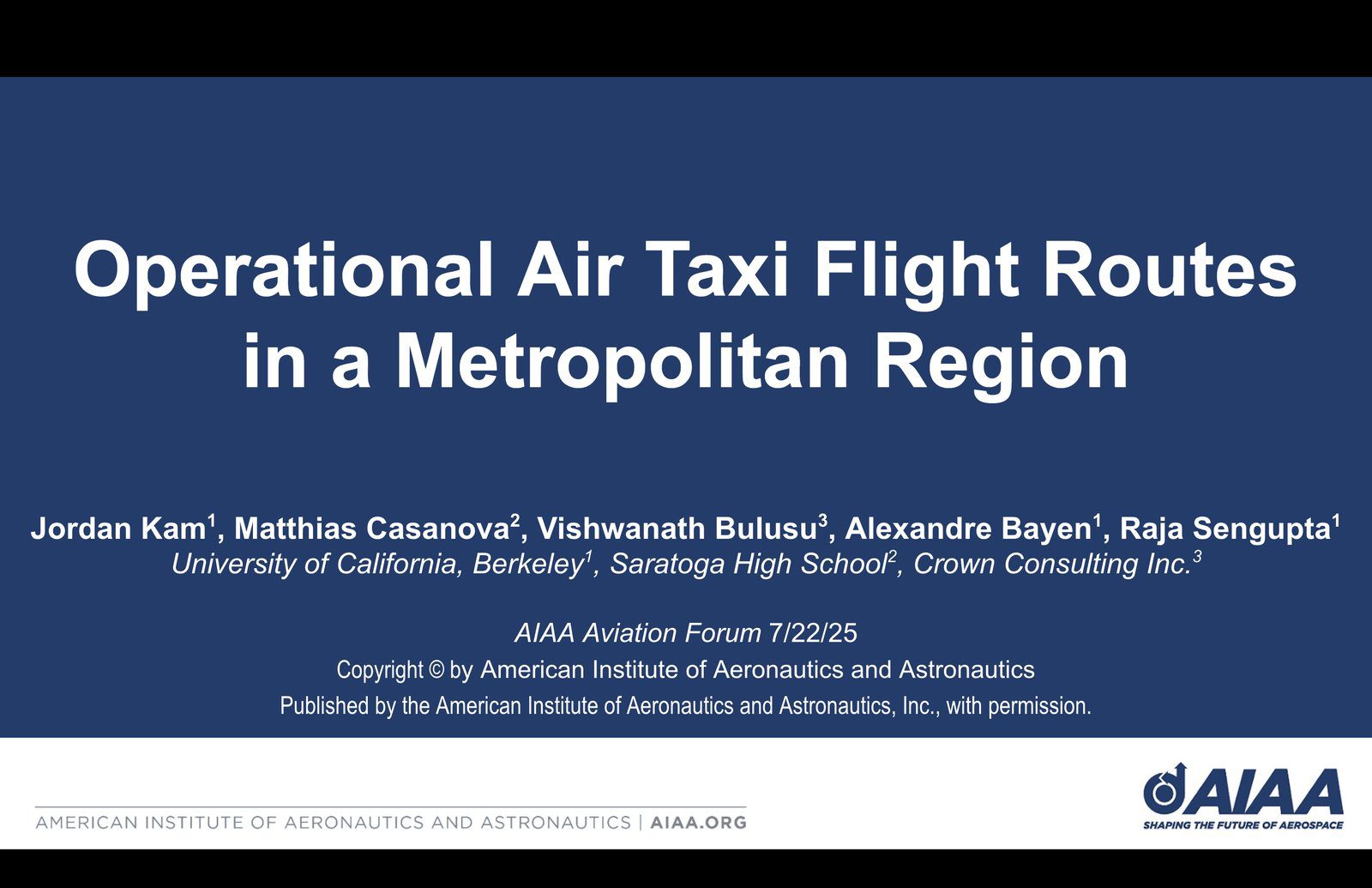
This summer I worked at NASA Ames Research Center with five other students on a question that sounds simple but isn’t: can you make air taxis quieter by changing how they climb? We spent the summer building models, writing code, and arguing about equations. The result was a NASA Technical Memorandum, A Dual-Approach Framework for eVTOL Climb Noise Mitigation.
The noise problem
Here’s the thing about eVTOL air taxis: they fly low. Really low. Commercial jets blast through your neighborhood for maybe 30 seconds on their way to cruising altitude. An air taxi leaving a vertiport on top of a hospital or apartment building is right there, buzzing over people’s heads for the entire climb. And the research on what that does to people isn’t great. Chronic aircraft noise is linked to stress, heart problems, and worse academic performance in kids. If people hate the sound, air taxis don’t happen. It’s that simple.
Why we focused on the climb
Of all the phases of flight, climb is where the noise problem is worst. The vehicle is close to the ground, the motors are working hard, and it lasts a while. We wanted to figure out whether changing the climb trajectory, basically the angle the vehicle flies upward at, could reduce the noise hitting people below.
We built two separate approaches. The first used an optimal control framework called PSOPT to generate climb paths at different angles for a reference quadrotor, then evaluated each one for Sound Exposure Level and energy use. The second was a deep reinforcement learning setup using a Double Deep Q-Network, where an agent learns to adjust the climb angle based on noise and energy feedback. The RL side is still in progress, but the idea is that the two methods can eventually validate each other.

What I actually worked on
My piece was the vehicle flight dynamics, the equations that describe how the quadrotor actually moves through the air. We started with a full six-axis dynamic model from prior NASA research and I had to simplify it so PSOPT could solve it in a reasonable amount of time. That meant locking the heading to 180 degrees (due south), holding lateral airspeed constant at 30 m/s, assuming zero roll, and plugging in a steady 5 m/s eastward wind based on San Francisco weather data.

What you end up with is a set of differential equations describing how vertical velocity, latitude, longitude, and altitude change over time as the vehicle climbs from 15 meters above ground up to a cruise altitude of 488 meters. Those equations are what PSOPT uses to generate feasible trajectories at each climb angle we want to test.

What the numbers say
The results were pretty clear. Shallow climbs, around 30 degrees, are the worst on both counts: the vehicle burns the most energy and produces the most noise. That makes sense when you think about it. A shallow climb keeps the aircraft low and close to people for longer. As the angle gets steeper, noise and energy both drop. Between 45 and 60 degrees is where things look best. Go much steeper than that and energy consumption shoots back up because you’re fighting gravity more directly.
These are preliminary results from the optimal control side only. The reinforcement learning agent is designed but hasn’t been trained yet. That’s next.
What’s next
We want to extend the framework past the climb phase to include cruise, swap in NASA’s AirNoiseUAM tool for more accurate noise modeling, and actually train the RL agent. There’s a lot left to do. But the basic finding, that trajectory angle alone can meaningfully shift noise exposure, feels like it’s worth chasing further. Thanks to our mentors Priyank Pradeep and Lindsay Stevens, and to the Aviation Systems Division at NASA Ames for the incredible opportunity.